Showing posts with label Great Britain. Show all posts

Monday, 16 May 2022

Bath in Somerset - rubber duck not included

Bath, Somerset, England.
An ancient city dressed in honey-coloured Georgian elegance, steeped in Roman history, and proudly listed as a UNESCO World Heritage Site. It’s the sort of place where the past isn’t just preserved—it’s parked on every street corner like a politely stationary time machine.

Hop-on-hop-off tourist buses weave through the city, and if you find yourself on the open-air top deck during a downpour, you’ll notice something delightfully practical: plug holes. Yes, real drains to stop rainwater from pooling like—well, like a bath.

I’m fairly certain all open-top buses have them, but the quiet delight of noticing this in a city literally named Bath felt like the sort of accidental poetry that stays with you. Sadly, no rubber duck floated by.

Before you even arrive in Bath, you must pass through Somerset, the county that surrounds it. It's comprehensively lovely—quintessentially English in the way postcards promise. 

Picture rolling green hills, a lattice of hedgerows, and vast pastures. People have been calling this area home since the Paleolithic era (think Fred Flintstone), followed by the Celts, Romans, and Anglo-Saxons—each leaving a footprint in the soil or stone.

A short hop away, Cheddar Gorge offers not just stunning scenery but serious archaeological cred. It’s home to Cheddar Man, the UK’s oldest complete human skeleton, dating back to 7,150 B.C. (No, not made of cheese, in case that crossed your mind). 

Meanwhile, Glastonbury—home to the famously muddy music festival—sits on what’s known as a "dry point," meaning it's one of the few flood-free bits of ground in the area. Irony noted.

Back in Bath, the Royal Crescent stands as one of the finest examples of Georgian architecture in the country—a graceful arc of 30 terraced houses, all uniform yet grand, and listed as Grade I, which in UK terms means: do not mess with it.

Across town, the Roman Baths offer a glimpse into ancient spa culture. In Roman times, a day wasn’t complete without a good steam, a communal soak, and perhaps a bit of philosophising about empire over hot water. It was muscle recovery meets mindfulness—a wellness trend about two millennia ahead of its time.

The city’s spa tradition hasn’t gone cold. In 2021, Bath was added to the UNESCO list of Great Spa Towns of Europe, celebrated for their natural mineral springs. One wonders about the modern infrastructure behind it all—filtration systems, maintenance budgets, the quiet toil of keeping ancient rituals hygienic.

Also worth noting: Uranus was discovered here. Yes, really. In 1781, local resident William Herschel spotted the planet from his backyard using a homemade telescope. It remains one of the more awkward astronomical announcements in history, but his Georgian house now serves as a museum, so everyone wins in the end.

Bath is a short train ride from London, but don’t make the mistake of trying to squeeze it into a day trip. There’s far too much to soak in.


Saturday, 14 May 2022

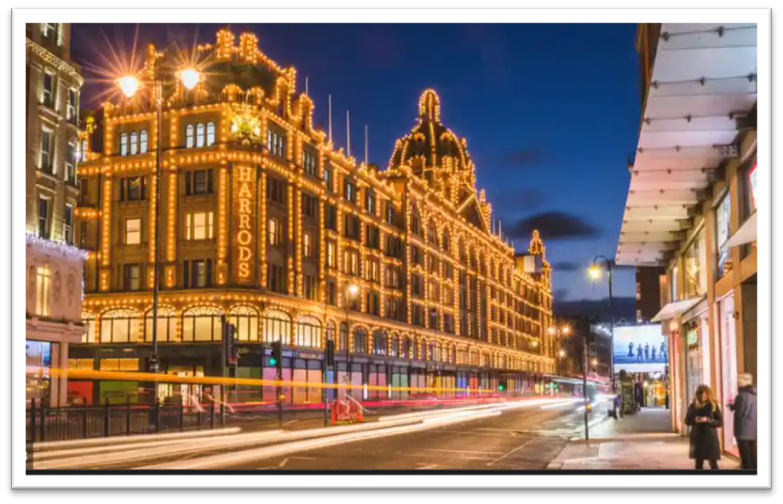
Harrods - and that time they sold lions

Today the writing challenge is heading to one of the most celebrated department stores in the world, Harrods of London. It might not strictly meet the brief of places of historical significance, and I appreciate any concern you might have on the matter, and any confusion or inconvenience caused, but Harrods has a long history. And it’s my blog. Also, disclaimer, Harrods is absolutely my favourite. 

In term of shopping centres, it doesn’t get any more exclusive that Harrods, which has voted itself the “world’s most famous department store”, and who can disagree with the GOAT. 

The largest department store in Europe, it is the land of opulence and luxury, lavishness and magnificence, with more than 300 in-house departments in store, and 100,000m2 of fancy handbags, Prada gold clubs and all of the other fabulousness they stock on their shelves. They probably don’t call them shelves; that is too…..Sainsburys. They probably call then product royal mantels, or something. 

Harrods came from modest little beginnings, as everything must do at some point. In 1832, a wee London East End grocery store was established and named after its owner, Mr Harrod. Mr Harrod developed a business portfolio and had some stores about town, that sold various items for which Harrods is now synonymous, but on a much less grander scale. 

The site on which Harrods stands now became a key asset for Mr Harrod and sold perfumes, stationary, medicines and fruit and vegetables. It was not unusual to bump into Sigmund Freud or Oscar Wilde at the checkouts, with Freud psychoanalysing your shopping basket and determining that your Id is well and truly in charge of your grocery list.

Harrods was first to introduce an escalator, because you can’t have Mr Freud wasting all his thought time trying to negotiate stairs when he’s busy psychoanalysing customers. Speaking of psychotic, in the early days, Harrods used to also sell cocaine. In 1916, it used to sell a kit containing cocaine, morphine, syringes and needles, as a present to send to friends on the front in the war. 

And at one point, the store used live snakes to guard expensive jewellery and also introduced the selling of exotic animals including panthers, alligators and lions. Which is awful and extremely random but also so very Edwardian era. In more uplifting news, Harrods has a chip shop in its food and beverage enclave. 

It also has a fabulous souvenir gift store. I own one of Harrods signature items, a shiny olive green tote bag that they sell to the innumerable tourists who pass through the checkouts. I also own a grey one. I’m a sucker for this sort of stuff and have never met a London souvenir that I have not fell instantly in love with in a very serious way. I’ve got three pens that look like the London Buckingham Palace guards, and you press their fur hat to click the pen open. Adorable.

And here’s a cool thing. The new head honcho pastry chef at Harrods is an Aussie. Philip Khoury started working there in 2018 and in December 2021 he was appointed the boss of all things sweet tooth. What a gig! 

In this time, he has begun pioneering plant-based dessert, which he calls the “last frontier” of vegan cuisine, rethinking the traditional eggs and dairy based model as the holy grail of exceptional desserts. Apparently kicking out dairy from the recipe allows other flavours to pop. 

This is interesting, as the global plant-based food market is expected to reach $USD70 million in the next five years, and certainly is projected to double in the UK in that time. Presumably this is a calculated move by Harrods to play in the USD$7 billion plant-based food market (up from USD$5.5 billion in 2019) as consumers are more and more aware around issues relating to food sustainability and nutrition of the products they are consuming. And with up to 300,000 customers a day at its peak, Harrods has an influential role to play.

And if you are lucky enough to visit the beautiful, gargantuan money spinner that is Harrods, and need somewhere to park the Ferrari or the Vauxhall Astra, there is a single carpark nearby that you can buy for a cool £85,000, which is ostensibly about £84,995 more expensive than other parks in the area. 

It comes with a fob, CCTV, a water supply (unclear if they mean a tap, or an Agean Sea type body of water), and a 960 year lease. Yeah, I give the Ferrari engine three months before it blows, let alone 960 years. Or you can just take the Tube like the rest of London.

Wednesday, 25 September 2019

TV REVIEW: I watched Midsomer Murders

I love a good old fashioned depraved murder as much as the next guy with a cold heart and a television remote. 

British old-school television show Midsomer Murders really sets the gold standard for people killing off other people in spectacularly perverse and unrealistic ways.  

And there's none of that new world Netflix business where you have to guess the plot because the TV show title is just a bit too clever. There gonna be murders in Midsomer.

There is something about a quaint little chocolate box village that has a tendency for murdering just about everybody who walks its cobblestones.

And as in all loosely based detective narratives, never in the history of the township of Midsomer has anyone ever linked any murder to the one that happened on the show just last week, or the week before that. They are all completely unrelated obviously and why would you even question that?

Here are some of my thought bubbles as dastardly events took place:

  • Detective Chief Inspector (DCI) Barnaby, the superstar super-detective super detective chief inspector of the show, seems to stay cheery despite the fact his beat is full of innovative sociopaths.
  • DCI Barnaby spends much of his shift being accosted by little old ladies who like to spill all the sordid, scandalous personal secrets of the villagers. Which are invariably not relevant to any case he’s working on, but are quite useful for a mental filing of every villager into some sort of alphabetical list of nutters. 

  • There's that guy in a hoodie who's been watching him in every scene of this episode. This time he's hiding in the bushes. Now he's on the run. DCI decides to chase him into an abandoned, dilapidated building, still not having called for backup. I'm sure the guy’s harmless.
  • It's an old boarded up house and the music is getting a bit hair-raising. DCI Barnaby goes in. Sorry, false alarm, nobody got murdered here.
  • This new guy has intricately detailed appointments in his diary apart from this mysterious one that seems to coincide with the time of murder. I'm sure it was a legit appointment. DCI decides there's no need to check it out any further.
  • DCI Barnaby returns to the crime scene at night by himself for no apparent reason. A man with no apparent reason to be there yells at him "what the hell are you doing here. You shouldn't have come back". DCI leaves the area. There was no reason to further question the crazy man, apparently. Pretty sure cops would find him a person of interest. What's the point of this scene? As an armchair crime-solving enthusiast, it's becoming increasingly difficult for me to weed out the killer/s from all the village nutters.
  • By my count, 180 people have being murdered so far in this episode.
Midsomer Murders is based on the real-life village of Midsomer Norton, a cutesy township in Somerset, England, not far from Bath, which is so named because it was quite popular amongst the Romans as the place to conduct their annual cleansing of the body.

Land owners in Somerset should consider themselves lucky they didn’t call their bathing spots jacuzzis.

The writer of Midsomer Murders found Midsomer Norton on a map and thought it sounded quintessentially British and sufficiently murderous. Is Midsomer Norton really like its television twin? 

Well, the crime stats of the real village indicate a boringly average amount of crime occurring in the township, with anti-social behaviour the most prevalent type of criminal activity. 


I’m a little hazy on the actual definition of murder, but I imagine it is certainly a fairly anti-social thing to do, so it may be more similar than we think.

I actually visited Midsomer Norton in July 2014. We were travelling through Somerset, mainly to attend the lovely city of Bath, and our hotel was a couple of miles from Midsomer Norton.

By some extraordinary stroke of luck, we were not murdered or even attacked by anti-social behaviour while walking the mean cobblestones of the pretty high street to get to Sainsburys in Midsomer, but there’s always next episode.

Thursday, 28 February 2019

I watched Downton Abbey.


The lovely electronic people who operate the buttons at Foxtel are replaying the sixth and final season of my beloved Downton Abbey, the British historical period drama about a centuries-old estate in England in which a bunch of obscenely rich people sit around drinking tea and whinging about their society friends. It's exactly the same as 2019, but with less comfortable clothes.

In it's 2011-16 hey day, Downton Abbey was among my favouritest TV programs. 

I honestly don't know why Britian's ITV brought it to an end; they could have kept this ship sailing all the way to the 1970s, with Lady Mary now in her early 70s and rocking high cut boots and a technicolour cowl neck sweater. Mr Carson, the house butler, would be still ruling the roost at about 170 years old.

The final season is set in 1925, which will go well to explaining why not one person has a mobile phone glued to their hand. They just had to remain stoic in the face of great suffering without Snapchat filters to cheer them up.

If  they wanted to communicate with each other in 1925 they had to telegram each other, or travel by early, early model crappy cars for hours and hours to reach each other to communicate a thought bubble that could have just been texted with a smiley face emoticon attached. 

Or, and this is the worst of all, they had to pick up a thing that was attached to a machine that was attached to a wall and put it near their ear until they heard voices on the other end! Absurd! Thankfully, everyone in the West is now in complete agreement that  speaking to another person on a telephone is passé and no longer worth our time.

For context, other things that happened in 1925 include the release of Hitler’s Mein Kampf, The Great Gatsby, Phantom of the Opera and Ben Hur, giant tornadoes in the U.S., UKs Child Labor Laws, Mussolini took over Italy, an airship crashed over Ohio, lots of airlines were formed around the world, diptheria outbreak, scotch tape was invented. Scotch Tape! All the things.

For more context - because I acknowledge the last bit of context was not particularly helpful in following the show's storyline - the people who sleep in the comfy beds in Downton Abbey are very rich. They have significant material wealth and also significant mounts of butter on their toast in the morning. I have noticed. Rich in many ways. Both of which sort of kill you in very different ways. 

Downton Abbey, season six, episode 5 or something:

SPOILERS!

Action!

Lord Grantham is recovering from last week’s episode, when his ulcer came out of his mouth in a bloody explosion. Too much butter on his toast probably. He is bedridden and has to receive incessant visits from his family all day because Netflix wasn’t invented. I suppose he could have entertained himself with a newly minted roll of scotch tape.

Kitchenhand Daisy speaks something annoying and annoys me.

The Crawleys  - the custodians of Downton Abbey - are planning to open the house to the peasants to raise money for the local Hospital. Don’t do it, Crawleys. As it turns out, the Open House is a roaring success, except for the common people ambling around their grand home, looking at the artworks with their dirt-poor, commoner eyes and dragging their pauper backsides across the antique furniture and carpets.

All the poor people have to wear dogpoo brown and dogpoo grey because Supre and other synthetic clothes from China were not invented yet.

Everyone gathers in the drawing room over and over again for tea and tedious, fairly pointless conversation.

Mr Bates and Anna, two of the house staff, have a conversation after work in their dark and depressing living room. “What about a fire? It’s a bit indulgent but we’ve earnt it today”. Everything I hate about ye olden times in one handy sentence.

Again, sitting around drinking tea. Always sitting around drinking tea. But they still do that today in England, because it’s always cold, grey tea-drinking weather. I also like drinking tea, because tea is everything that is right and good in the world. Viva la Downton Abbey.

Tsunami in Waikiki

The tsunami sirens wailed across Waikiki, slicing through the usual tropical stillness. We were warned: one hour until impact. A massive wav...